Perimenopause and menopause: a change in hormones, not an ending
Menopause is when periods stop for good because the ovaries stop releasing eggs and making most of their oestrogen and progesterone. The years of change before it, perimenopause, can bring hot flushes, poor sleep, low mood and brain fog. Changes you cannot see, in fat, muscle, bone and heart health, matter for the rest of life. This guide explains what happens, which food and lifestyle advice has good evidence, and why access to care is not yet equal.

From regular periods to after the menopause
Where the change starts: the ovaries
The two ovaries hold follicles, tiny sacs that each contain an egg. Through the reproductive years they release eggs and make most of the body's oestrogen and progesterone. At menopause they stop releasing eggs and secreting these hormones, so periods stop and oestrogen levels fall.
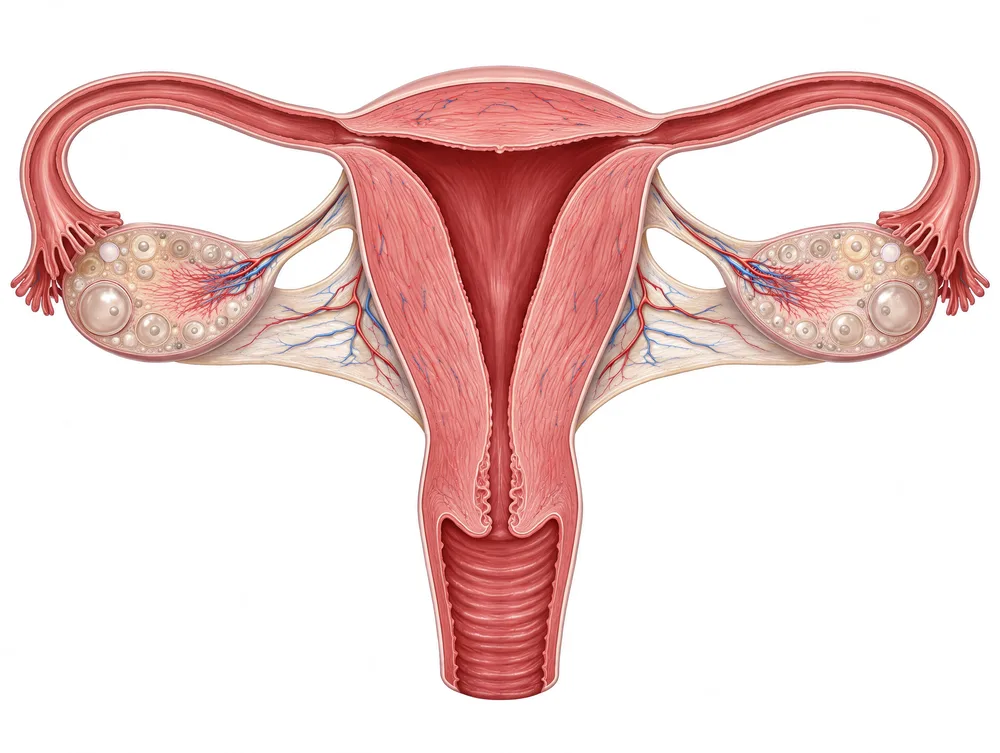 OvaryOvary
Fallopian tubeWomb (uterus)
Follicles
NICE NG23 glossary. Illustration generated for MaDiet; simplified, not to scale.
Researchers describe the journey in stages, known as STRAW+10, which apply "regardless of women's age, ethnicity, body size, or lifestyle". Tap a stage.
Harlow and others, STRAW+10, 2012; NICE NG23 definitions; SWAN (Greendale and others, JCI Insight 2019); BDA Food Fact Sheet on menopause.
When does it happen?
Most people reach menopause between 45 and 55. In the UK the average age is 51.
- Premature ovarian insufficiency (POI) is menopause before 40, either natural or after medical or surgical treatment.
- Early menopause is between 40 and 44. NICE recommends offering psychological support to people who find it distressing.
- Surgical or treatment-induced menopause can bring symptoms more suddenly and sometimes more severely.
- NICE notes that "people from some ethnic minority backgrounds and people with some lifelong conditions may experience menopause at a younger age". Some studies, mostly outside the UK, suggest an earlier average age in some groups, but a large US study (SWAN) found ethnicity was not linked to age at menopause once other factors such as smoking were taken into account. There are no UK population figures by ethnicity.
NHS inform, Menopause; NICE NG23 (recommendations 1.2.7, 1.3.3); El Khoudary and others, SWAN progress report, Menopause 2019; BMS tool for clinicians, Menopause in ethnic minority women, 2023.
Why a falling hormone can feel like a heatwave
Deep in the brain, a group of nerve cells (called KNDy neurons) helps set the body's thermostat. Oestrogen normally keeps them calm. When oestrogen falls, they become overactive and release more of a messenger called neurokinin B. The comfortable temperature range narrows, so a tiny rise in body temperature now sets off the "cool down" response: flushing skin, sweating and a racing heart. This is the pathway that the newer non-hormonal medicine fezolinetant blocks.
Concept diagram without units, based on reviews in Nature Reviews Endocrinology (2026) and BJOG on KNDy neurons and neurokinin B. Much of the circuit was mapped in animal studies; the human evidence comes from neurokinin B infusion studies and medicine trials.
How long do hot flushes last?
In the US SWAN study of 1,449 women with frequent hot flushes or night sweats, they lasted a median of 7.4 years in total, and 4.5 years after the final period. They lasted longest when they started early in perimenopause (more than 11.8 years). The NHS now says symptoms usually last 7 to 9 years, sometimes longer, which fits the whole journey rather than just the years after the final period.
Avis and others, JAMA Internal Medicine 2015. US groups as named in the study; they do not match UK ethnic categories.
More than hot flushes
NHS inform lists these common symptoms. Some people have few or none. Tap one to learn more.
NHS inform, Menopause; NICE NG23 (definitions of genitourinary symptoms; recommendations on mood and CBT); SWAN on cognition (El Khoudary and others 2019).
The scales can hide what is changing
In SWAN, which measured body composition through the transition, "at the start of the menopause transition, rate of fat gain doubled, and lean mass declined; gains and losses continued until 2 years after the final period". Weight itself did not speed up. Move the slider.
Concept diagram from Greendale and others, JCI Insight 2019 (SWAN). Shaded area: from the start of the transition to 2 years after the final period. On average lean mass fell by 0.7%, but a quarter of women lost 4.7% or more, and greater loss predicted later fractures (SWAN, JBMR 2023).
Bone
Falling oestrogen speeds up the loss of calcium and other minerals from bone, which raises the risk of osteoporosis and fractures later. NICE asks clinicians to give bone health advice. HRT lowers the risk of fragility fractures while it is taken, but the benefit fades after stopping.
BDA Food Fact Sheet; NICE NG23 (recommendation 1.2.4 and HRT risk information).
Heart
Oestrogen helps protect against heart disease. Around menopause, blood pressure and cholesterol often rise without any symptoms. This is why heart-healthy eating matters more in midlife. NICE says HRT should not be offered to prevent heart disease or dementia.
BMS/Women's Health Concern, Nutrition in menopause; BDA Food Fact Sheet; NICE NG23 (recommendations 1.6.4–1.6.5).
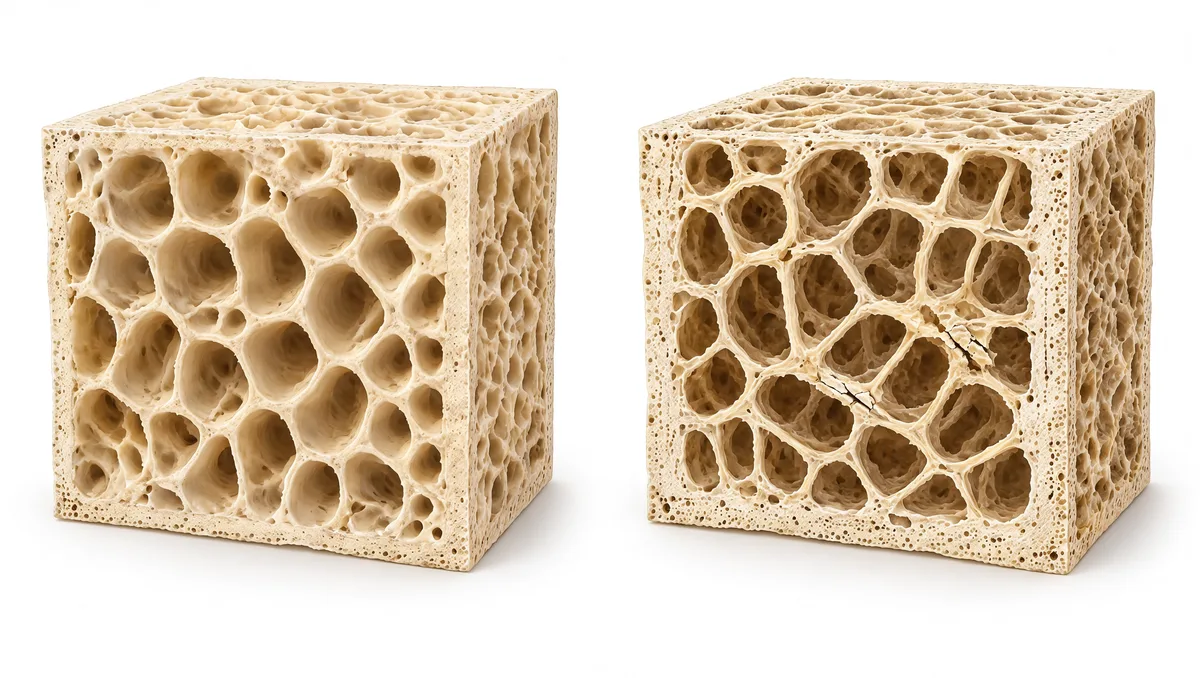 Healthy boneOsteoporosis
Curtis and others, Bone 2016 and author reply; Klop and others, Osteoporosis International 2017; SACN/Public Health England vitamin D advice, 2016.
Eating for bones, heart and muscle
UK advice for menopause is not a special diet. The best evidence is for protecting bones, heart and muscle for the years ahead.
Calcium and vitamin D
- Adults need 700 mg of calcium a day. The British Menopause Society suggests 700–1,200 mg depending on osteoporosis risk, roughly 2–3 servings of calcium-rich foods a day.
- Vitamin D 10 micrograms a day from October to March, or all year for people with darker skin.
- US sources often quote 1,200 mg for everyone; UK figures are used here.
NHS calcium page; BMS/WHC Nutrition in menopause; BDA; Royal Osteoporosis Society; SACN 2016.
Muscle
- NICE asks clinicians to explain the importance of keeping muscle mass and strength through physical activity.
- Most people already eat enough protein. Eating more protein alone will not build muscle without strength exercise.
- See the energy and movement section of the obesity guide for strength and activity guidelines.
NICE NG23 (recommendation 1.2.5); BMS/WHC Nutrition in menopause.
Heart
- Swap saturated fats for unsaturated ones, such as vegetable oils, nuts and seeds.
- One portion (140 g) of oily fish a week.
- Salt 6 g a day or less; oats for their beta-glucan fibre.
- Aim for 30 g of fibre and at least 5 portions of fruit and vegetables a day, and keep free sugars to 30 g a day or less.
BMS/WHC Nutrition in menopause.
Iron
Iron needs fall once periods stop: the UK reference intake is 14.8 mg a day for women aged 19–49 and 8.7 mg a day from 50. But heavy or irregular bleeding in perimenopause makes iron especially important, and anyone still having periods after 50 may need the higher amount.
British Nutrition Foundation; NHS iron page; BMS/WHC Nutrition in menopause.
Calcium from many kitchens
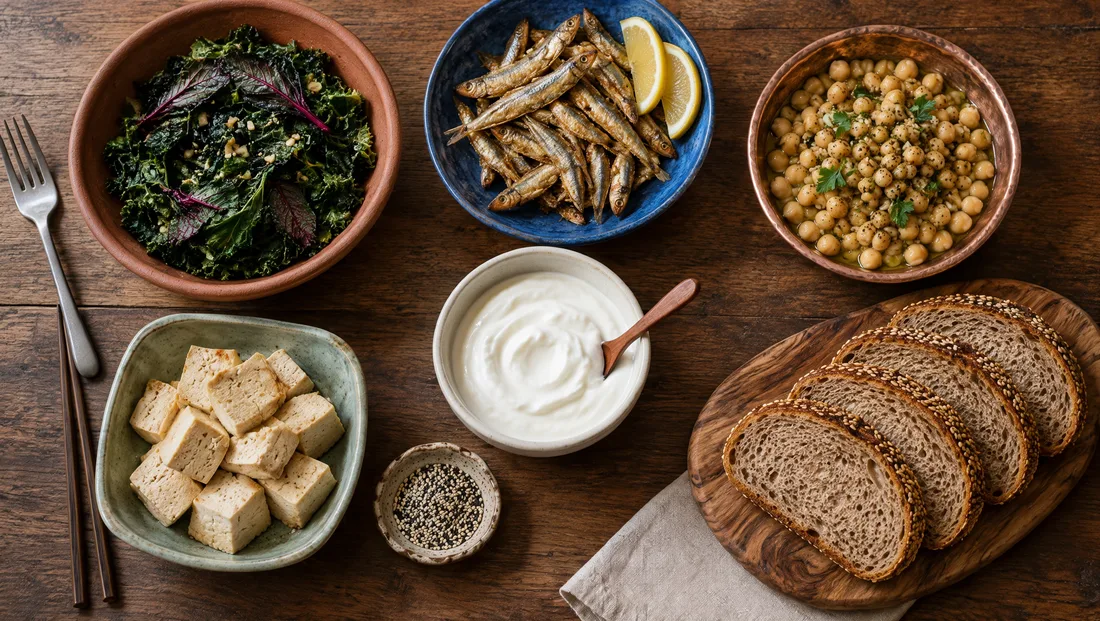
Calcium-rich foods, per 100 g as eaten, from the food tables in MaDiet's Foods from many kitchens. Leafy greens and small fish eaten with their bones are traditional calcium sources in many cuisines. Filter by region:
Values from WAFCT 2019 (West Africa), Congo Basin FCT 2023, Kenya FCT 2018, Ethiopian FCT 2025, Bangladesh FCT 2013, Japan 2015, Brazil TACO 2011, CFNI 1998 and CoFID 2021. Dishes marked "recipe" were calculated by the table compilers. Full codes are on the foods page.
Soy, "trigger foods" and supplements
- Soy and phytoestrogens: a Cochrane review of 43 trials found "no conclusive evidence" that phytoestrogen supplements reduce hot flushes and night sweats, and a strong placebo effect. A 2025 analysis found only a small effect. The Menopause Society (2023) does not recommend soy for hot flushes. Soy foods are healthy, and the British Menopause Society says people can try two servings a day for 2–3 months, but people with a history of breast cancer should avoid the high amounts used for symptom relief.
- "Trigger foods": some people notice that caffeine, alcohol or spicy food set off their flushes. That is worth noting for yourself, but trials have not shown that avoiding them reduces flushes, and The Menopause Society does not recommend trigger avoidance as a treatment.
- Supplements and herbal remedies: no specific supplements are recommended for menopause. NICE says isoflavones or black cohosh may help some people, but products vary, their safety is uncertain and they can interact with medicines. St John's wort interacts with medicines including tamoxifen. In the UK, black cohosh carries a warning that it may rarely cause liver problems. Ginseng and other Chinese herbal remedies lack evidence.
Lethaby and others, Cochrane 2013; Menopause Society 2023 nonhormone therapy position statement; 2025 soy isoflavone meta-analysis (PMC12296567); BMS/WHC Nutrition in menopause; NICE NG23 (recommendations 1.4.7–1.4.8); MHRA, black cohosh (2006, reminder 2012).
What to expect from your GP
DiagnosisWhen blood tests are and are not needed.
- From age 45, perimenopause and menopause are usually recognised from symptoms, without blood tests.
- A hormone (FSH) blood test may be considered between 40 and 45 with symptoms and changed periods, or under 40.
- POI is diagnosed from symptoms plus raised FSH on two blood samples 4–6 weeks apart, never on one test.
NICE NG23, recommendations 1.3.1–1.3.6 and 1.7.2–1.7.3.
Treatment options to discussHRT, CBT, fezolinetant and vaginal treatments.
- HRT is the main treatment for hot flushes. Benefits and risks depend on the type, the way it is taken and the person; NICE has a discussion aid to help. Oestrogen through the skin (patch or gel) does not raise blood-clot risk above the general population at standard doses.
- CBT designed for menopause can help hot flushes, sleep and low mood, alongside or instead of HRT.
- Fezolinetant, a non-hormonal tablet, is recommended by NICE (March 2026) for moderate to severe flushes when HRT is unsuitable. It needs liver blood tests.
- Vaginal oestrogen, moisturisers and lubricants help vaginal dryness and discomfort.
NICE NG23 (2024 update); NICE TA1143 (fezolinetant, 31 March 2026); MHRA Drug Safety Update, April 2025.
NICE NG12 (recommendation 1.5.12); NICE NG23.
Menopause and workWhat a 2022 UK survey found.
In a 2022 UK survey of over 4,000 women aged 45–55, 44% said menopause affected their ability to work and 1 in 10 of those who worked through it had left a job because of symptoms, though that figure is often over-stated. A 2023 CIPD survey found 17% had considered leaving work because of a lack of support, and 6% had left.
Fawcett Society, Menopause and the Workplace (2022), and LSE Business Review critique (2025); CIPD, Menopause in the workplace (2023).
Who gets HRT in England?
A study of nearly 2 million women aged 40–60 in English GP records (2013–2023) looked at who received at least two HRT prescriptions.
Hirst and others, BMJ Medicine 2025;4:e001349.
Hirst and others, BMJ Medicine 2025; BJGP 2025 (women's and clinicians' interview studies); BMS tool for clinicians, Menopause in ethnic minority women (2023): "limited research evidence of menopause experiences in British ethnic minority women".
Trusted places for more helpNHS, Women's Health Concern, BDA and more.
- NHS inform: Menopause
- Women's Health Concern (patient arm of the British Menopause Society), including the fact sheets used here
- BDA Food Fact Sheet: Menopause
- Royal Osteoporosis Society, for bone health information
- NICE NG23 and its HRT discussion aid
Things people often hear about menopause
Menopause comes with a lot of advice from family, friends and social media. Some of it is true, some is half true and some is simply wrong. Tap a statement to see what the evidence says.
NHS: Menopause and perimenopause symptoms; When to take HRT (NHS website, viewed 15 November 2026). NHS 111 Wales: Hormone replacement therapy. NICE NG23 and its information for the public, Benefits and risks of HRT. British Menopause Society consensus statement on bioidentical HRT (reviewed April 2026). SWAN: Avis and others 2015; Greendale and others 2019; SWAN physical activity and weight analysis, Am J Epidemiol 2004. BJGP 2025 interview studies. MHRA black cohosh warning.